
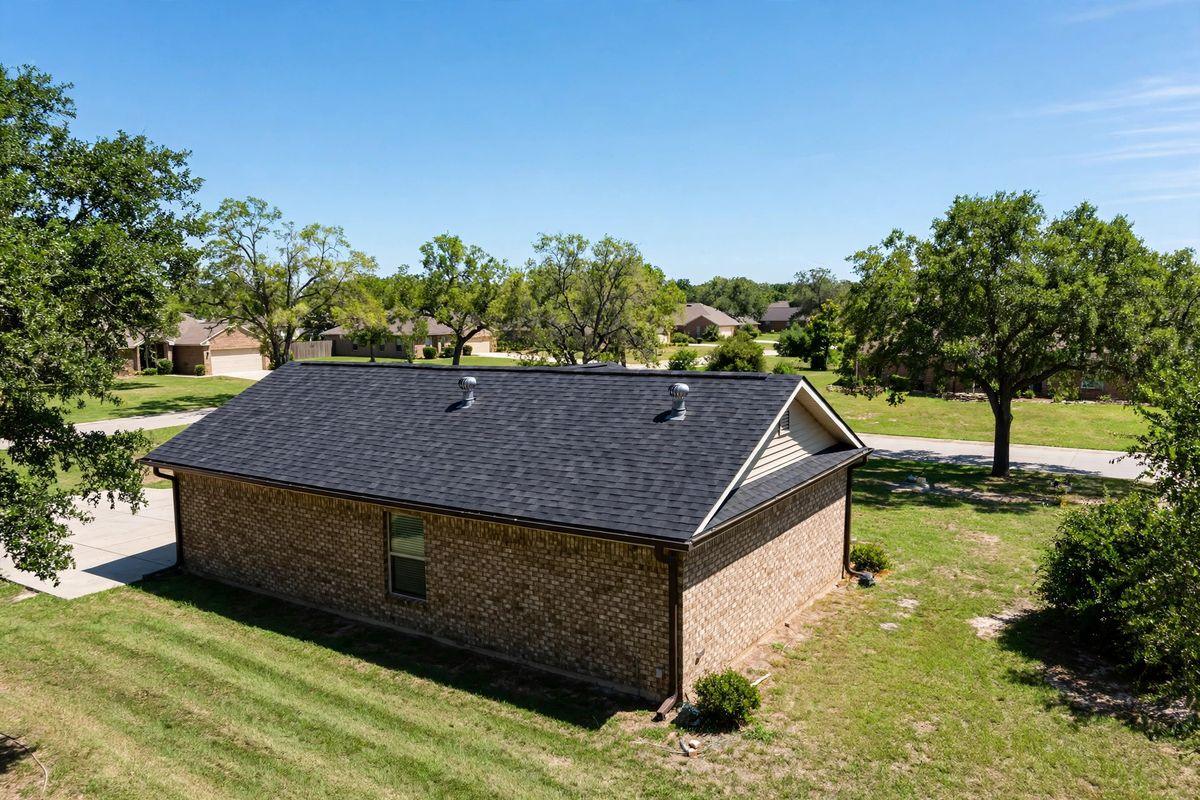
How roof ventilation works
Ventilation is a loop. Intake vents in the soffit pull outside air in low, and exhaust vents near the peak let hot air out high. Because heat rises, the loop mostly runs itself, as long as both halves are open and roughly balanced. The exhaust half is the part you can see from the street: a ridge vent along the peak, turbine vents (the spinning whirlybirds on many Huntsville roofs), box vents, or a powered attic fan.
What weak ventilation does
- It cooks shingles from below. Trapped attic heat ages asphalt shingles faster, so the roof wears out ahead of schedule.
- It raises cooling costs. A superheated attic sits directly above your living space and keeps the air conditioner working harder and longer.
- It traps moisture. Humid East Texas air that cannot escape can condense on the underside of the decking during cooler months.
- It can complicate warranties. Shingle manufacturers specify ventilation in their installation instructions, and a badly vented roof can complicate a warranty claim.
Signs your attic is not breathing
- Upstairs rooms stay noticeably hotter than the ground floor on still afternoons.
- The air conditioner runs almost nonstop on sunny days.
- Shingles curl or age unevenly, worst on the sunniest slopes.
- The attic smells musty, or you spot rusty nail tips and dark staining under the deck.
The balance rule roofers use
The common standard is 1 square foot of net free vent area for every 300 square feet of attic floor when a vapor barrier is in place, or 1 to 150 without one, split evenly between intake and exhaust. Balance matters as much as the total. Too much exhaust can pull conditioned air out of the house instead of pulling air from the soffits, and mixing exhaust types, such as turbines alongside a ridge vent, can short circuit the loop, because the stronger vent draws from the weaker one instead of from below.
Fixes that actually help
- Clear blocked soffits. Insulation pushed over the intake vents is the most common blockage. Baffles hold the channel open.
- Add ridge venting at replacement time. It is cheapest during a residential roof replacement, while the deck is exposed.
- Keep turbines honest. A bent, noisy or seized turbine moves almost no air. Replace bad ones.
- Consider a solar attic fan where a ridge vent does not suit the roof shape, sized to the attic it serves.
When to have it checked
Ventilation rarely fails loudly. It shows up as a roof that ages early and a house that costs too much to cool. If either sounds familiar, ask for the vents and soffits to be checked as part of a roof inspection, and get any fix priced in writing.
Educational overview, not a quote, insurance advice or a professional inspection.
Related: Roof Inspection Residential Roof Replacement Roof Repair vs. Roof Replacement